Why East Coast Collective calls KwaZulu-Natal home
The Case for the East Coast
"There is a curiously elusive charm to the nature of the fair land of Natal. It was this medley of hills and valleys which the great chief Shaka made into a kingdom for his Zulu people and perhaps it was the blood he shed which helps to make the place so wistful, with a piquant charm, endearing on sight to man, stirring his blood with envy and desire to possess so lovely a prize, and inspiring him to write there a human story full of contention, adventure and intrigue." — T.V. Bulpin, Natal and the Zulu Country (1966)
Ask most first-time visitors to picture South Africa and they will describe Cape Town: Table Mountain, the Winelands, a walk down to Cape Point with the ocean on both sides. It is a fair picture, and a beautiful one, and we take our guests there often with the help of the travel partners and private guides we work with in the Western Cape. But it is a picture of one corner of the country standing in for the whole of it, and somewhere in that substitution, most visitors miss the point of South Africa entirely.
The Western Cape is Mediterranean in its climate, its wine culture and its pace; handsome, but not, in any deep sense, African. True Africa, the Africa of open bush and old kingdoms, of coastline that has never been tamed into a promenade, lies east of it: in KwaZulu-Natal, in the Eastern Cape, in the provinces tourism has been slower to discover. We built East Coast Collective to guide the adventurous traveller there, to the coast Bulpin was writing about sixty years ago, because we believe it is where the country's real character lives.
A land built for adventure
Few places on earth pack safari, scuba diving, surfing, and centuries of cultural and military history into a single short drive. In KwaZulu-Natal you can paddle out into a perfect right-hander at first light, long before the wind gets up, and be watching a pride of lions by early afternoon; you can surf a glassy dawn session and still walk a Zulu battlefield before the day is done. It is a province that rewards restlessness, and it does so without asking you to sacrifice comfort: our guests move between it all from some of the finest private lodges in the country.
What strikes most visitors first is how little of it has been paved over. KZN's population and its urban growth have, for the most part, made room for the wild rather than replaced it. This is a province that still protects some of the oldest game reserves on earth: Hluhluwe-iMfolozi was proclaimed in 1895, making it the oldest formally protected reserve in Africa, and it was here, from a population that had dwindled to as few as twenty individuals, that the southern white rhino was pulled back from the edge of extinction. That single reserve is now home to roughly 1,600 of them. Few places carry that kind of conservation weight so lightly.
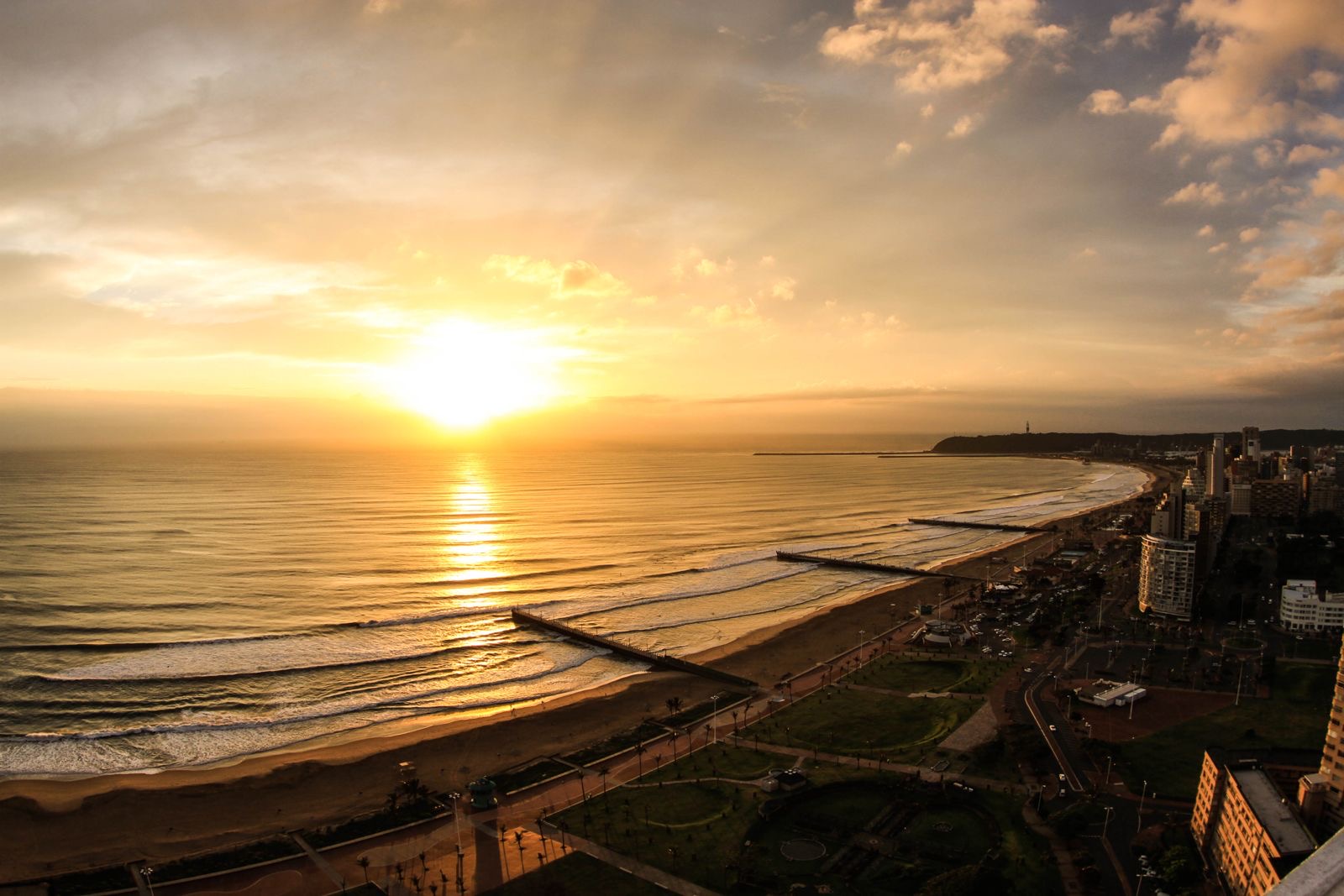
The landscape itself does the rest of the work. The climate is generous almost year round; the interior is lush in a way the Cape never is, all rolling green hills folding down toward a coastline warmed by the Mozambique Current. That warm water is what gives KZN's ocean its range: snorkelling and diving among some of the richest reef systems on the continent, point-break surfing that rivals anywhere in the world, the sardine run each winter, whale watching, and shark diving among ragged-tooth, and tiger sharks. All of it sits within an hour or two of a Big Five safari. It is difficult to name another coastline anywhere that offers as much, in as little distance, without any of it feeling diminished by the others.
A land worth fighting for
None of this is new. It is, if anything, the oldest story the land has to tell. As Bulpin traces in the opening pages of Natal and the Zulu Country, this coastline was shaped over hundreds of millions of years by lava, sea and river before a single person set foot on it: a four-thousand-foot flood of basalt buried and then slowly gave up the older sandstones beneath it, a subsiding coastline let the sea in and then released it again, and the rivers that remain still carry the silt that built Durban's own harbour, grain by grain, out of a tranquil lagoon. The Bushmen who lived beneath the Drakensberg left some of the finest rock art on the continent on the walls of its sandstone caves, long before history as we record it had begun.
It is no accident that a land this fertile and this beautiful became, later, a land people were prepared to die for. Shaka built a kingdom out of these hills and valleys; the battles that followed, Zulu, British, Boer, are written into the ground at Isandlwana, Rorke's Drift and a dozen other fields across the province. Every part of what makes KZN worth visiting today, its wildlife, its water, its climate, its very shape, comes out of that same violent, beautiful history. Bulpin understood that the charm of the place and the blood spilled over it were never really separate stories. We think that tension is still what gives KwaZulu-Natal its pull.
A province under real protection
The scale of what KwaZulu-Natal has set aside for conservation is worth putting in front of guests plainly, because numbers like these are rare anywhere in the world:
| Protected area | Type | Approx. size (hectares) |
|---|---|---|
| uKhahlamba-Drakensberg Park | UNESCO World Heritage Site | 242,913 |
| iSimangaliso Wetland Park | UNESCO World Heritage Site (South Africa's first) | 239,566 |
| Hluhluwe-iMfolozi Park | State reserve, oldest in Africa (est. 1895) | 96,000 |
| Tembe Elephant Park | State reserve | 30,000 |
| Ithala Game Reserve | State reserve | 29,653 |
| Phinda Private Game Reserve | Private reserve | 28,555 |
| Manyoni Private Game Reserve | Private reserve | 23,000 |
| Babanango Game Reserve | Private reserve | 20,000+ |
| Thanda Private Game Reserve | Private reserve | 16,500 |
| Somkhanda Community Game Reserve | Community-owned reserve | 12,000 |
| Ndumo Game Reserve | State reserve | 10,117 |
| Nambiti Private Game Reserve | Private reserve | 9,859 |
| uThukela Banks MPA | Marine Protected Area | ~566,600 |
| Protea Banks MPA | Marine Protected Area | ~120,000 |
| Aliwal Shoal MPA | Marine Protected Area | ~67,000 |
| Trafalgar MPA | Marine Protected Area | ~800 |
| Total — formal protection, land and sea | 1,512,563+ |
That comes to over 1.5 million hectares under formal protection, on land and at sea, and it is not a complete list. Ezemvelo KZN Wildlife alone manages several dozen further nature, forest and coastal reserves across the province, from the 26-hectare Umhlanga Lagoon reserve to Enseleni, Weenen, Karkloof and beyond, none of them included above. It is, by any measure, one of the most densely protected coastlines on the planet.*Figures are drawn from Ezemvelo KZN Wildlife, UNESCO, and reserve-specific sources.
Where we come in
We are not in the business of talking anyone out of Cape Town, and we never will be. What we are in the business of is making sure our guests do not leave South Africa believing they have seen it after a week in the Winelands. KwaZulu-Natal rewards a traveller who is willing to be active and a little bit adventurous, and it can be genuinely wild in places, which is exactly why local knowledge matters here more than almost anywhere else in the country. That is what East Coast Collective provides: guides who know which sandbank hides the ragged-tooth sharks and which stretch of the Drakensberg gets weather too fast to argue with, who can put a family safely on a wave in the morning and in front of a leopard by dusk, and who can do all of it while placing our guests in the same high-end lodges and camps that make the rest of the country's safari circuit famous.
The last thing we would want anyone to take from KwaZulu-Natal is the wildlife alone. It is the people who have made this coastline what it is, and the welcome you receive here, warm, direct and entirely unhurried, is as much a part of the destination as the reef or the reserve. Bulpin closed his own account of this land by returning to the story it wrote in its people. We think that is still exactly right.
More from the Journal